Lesson 1: Introduction to Cartesian Coordinates
Learning Objectives
By the end of this lesson, students will be able to:
- Understand the structure of the Cartesian coordinate system
- Plot points accurately on a coordinate plane
- Identify quadrants and understand positive/negative coordinates
- Recognize points that lie on axes
- Interpret coordinates from a diagram and a table
The Cartesian Coordinate System
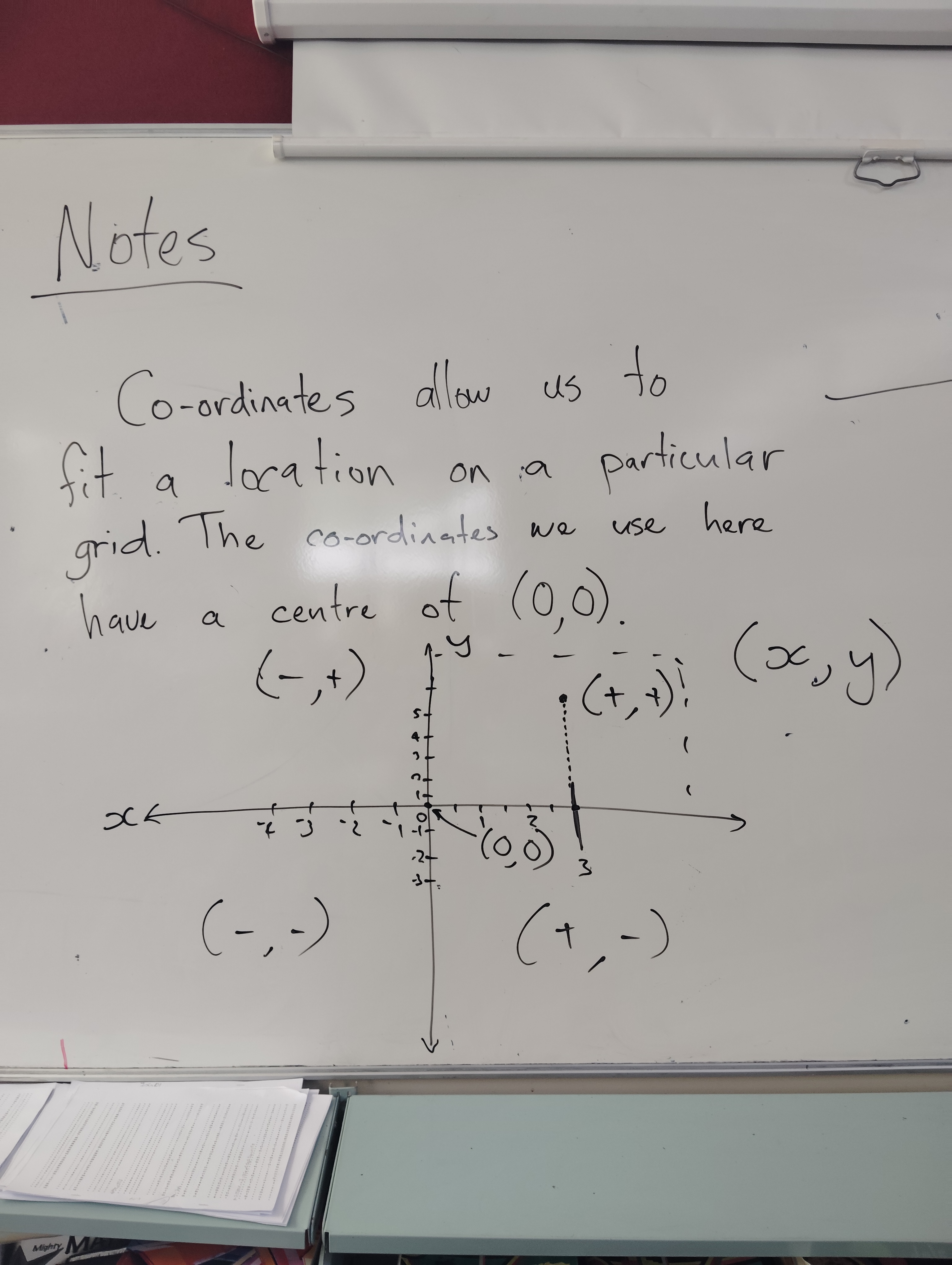
The Cartesian coordinate system uses two perpendicular number lines: - The x-axis (horizontal) - The y-axis (vertical)
The point where they intersect is called the origin, denoted as (0, 0).
Plotting Points
Each point in the plane is represented by an ordered pair (x, y): - The first number (x) tells us how far to move horizontally - The second number (y) tells us how far to move vertically
Example 1: Plotting Points
Plot the following points: - A(2, 3) - B(-1, 4) - C(-3, -2) - D(4, -1)
Example 2: Mixed Point Types
Plot each point and label it clearly:
- E(0, 4)
- F(5, 0)
- G(-6, 0)
- H(0, -3)
- I(2, -5)
- J(-4, 3)
Note: Points with \(x = 0\) lie on the y-axis. Points with \(y = 0\) lie on the x-axis.
Quadrants
The coordinate plane is divided into four quadrants: - Quadrant I: x > 0, y > 0 (top right) - Quadrant II: x < 0, y > 0 (top left) - Quadrant III: x < 0, y < 0 (bottom left) - Quadrant IV: x > 0, y < 0 (bottom right)
Example 2: Identifying Quadrants
In which quadrant does each point lie? - P(3, 5) → Quadrant I (both positive) - Q(-2, 7) → Quadrant II (x negative, y positive) - R(-4, -3) → Quadrant III (both negative) - S(6, -2) → Quadrant IV (x positive, y negative)
Points on the axes are not in any quadrant.
Example 3: Quadrant and Axis Check
For each point, state the quadrant or axis:
- U(0, 7)
- V(-8, 0)
- W(-2, 5)
- X(6, -1)
- Y(3, 0)
- Z(0, -6)
Practice Exercises
- Plot the following points on a coordinate plane:
- P(3, -2)
- Q(-4, 1)
- R(0, 5)
- S(-2, -3)
- T(4, 0)
- U(-6, 2)
- V(5, -4)
- Identify the quadrant or axis for each point:
- A(5, 7)
- B(-3, 2)
- C(-1, -6)
- D(4, -3)
- E(0, -8)
- F(9, 0)
- Complete the table:
| Point | \(x\) value | \(y\) value | Quadrant/Axis |
|---|---|---|---|
| G(2, 6) | |||
| H(-5, 4) | |||
| I(0, -3) | |||
| J(-7, 0) | |||
| K(-2, -5) |
- Name three points that lie:
- In Quadrant II
- On the x-axis
- On the y-axis
- Create your own set of four points, one in each quadrant, and swap with a classmate to plot and check.
Worksheet 1A: Plotting Points
- Plot the following points on a coordinate plane:
- A(4, 3)
- B(-2, 5)
- C(-3, -4)
- D(1, -2)
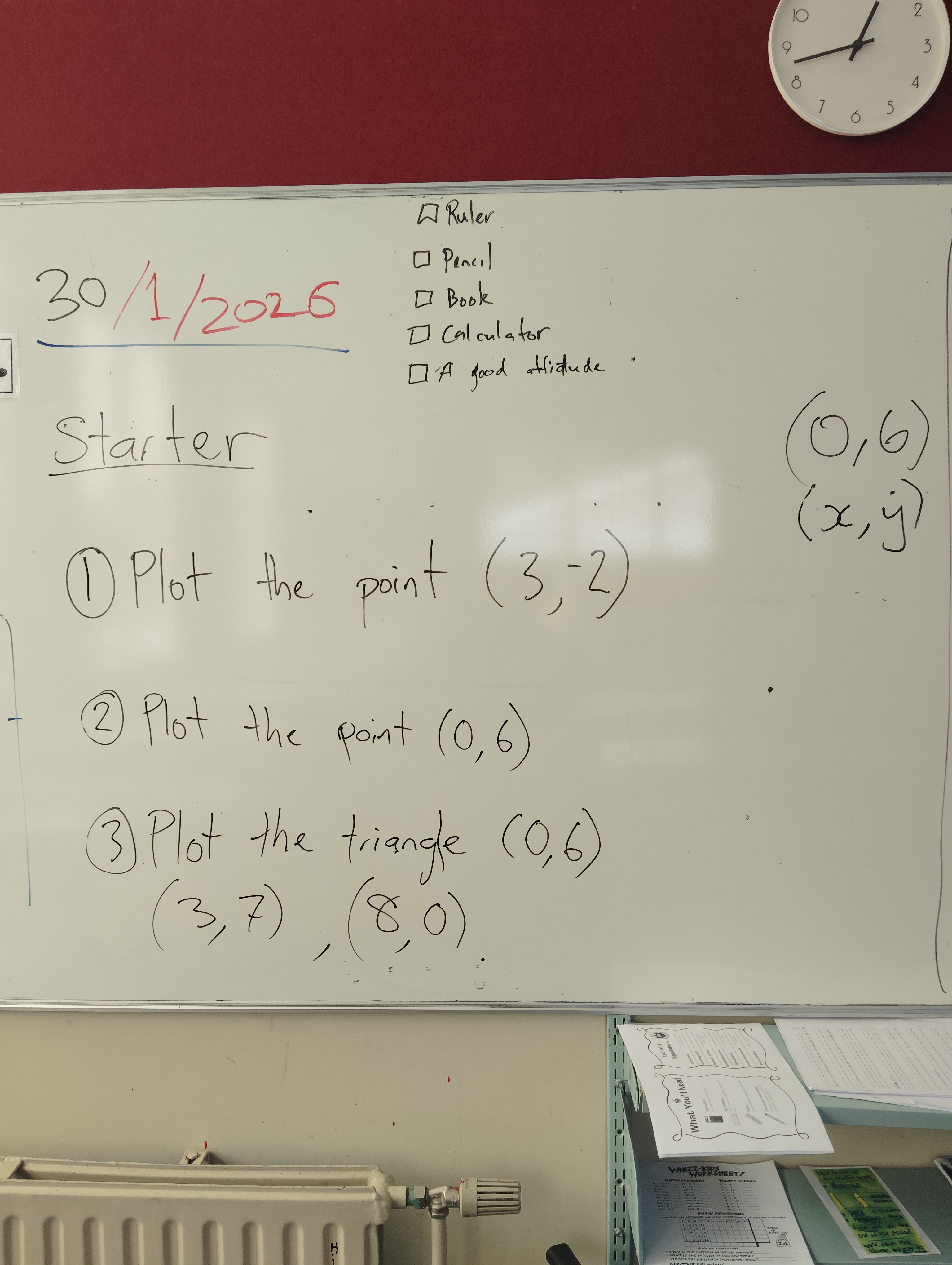
- E(0, 6)
Exit Ticket
- Plot and label: A(4, -2), B(-3, -1), C(0, 6).
- State the quadrant or axis for each point above.
- Write one coordinate that lies in Quadrant III and one that lies on the y-axis.
Homework
Complete the worksheet on coordinate geometry basics (see Resources).
Practice 1: P(3, -2) Q(-4, 1) R(0, 5) S(-2, -3) T(4, 0) U(-6, 2) V(5, -4)
Practice 2: A QI, B QII, C QIII, D QIV, E y-axis, F x-axis
Practice 3:
| Point | \(x\) value | \(y\) value | Quadrant/Axis |
|---|---|---|---|
| G(2, 6) | 2 | 6 | QI |
| H(-5, 4) | -5 | 4 | QII |
| I(0, -3) | 0 | -3 | y-axis |
| J(-7, 0) | -7 | 0 | x-axis |
| K(-2, -5) | -2 | -5 | QIII |
Practice 4: Any valid points.
Practice 5: Any valid set, one in each quadrant.
Exit Ticket (sample answers): 1. Plot as given. 2. A QIV, B QIII, C y-axis. 3. Example: (-2, -4) in QIII and (0, 5) on y-axis.
Worksheet 1A answers: A QI, B QII, C QIII, D QIV, E y-axis.
Next Lesson: Lesson 2: Map It - Scale, Coordinates, and Bearings